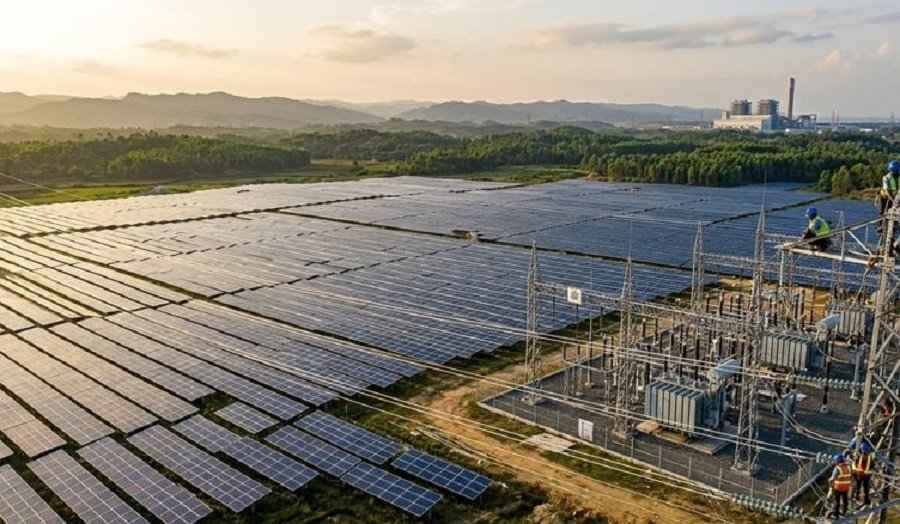
Around 918 megawatts (MW) of grid-connected solar power from the private sector is expected to be added to the national grid by 2028 as the government steps up efforts to expand renewable energy generation and reduce dependence on imported fossil fuels.
The Bangladesh Power Development Board (BPDB) has signed agreements with 12 independent power producers (IPPs) to generate 918MW of solar electricity at Tk 9.12 per kilowatt-hour, according to officials.
An official said the agreed tariff was around 2.5 cents lower than the cost of similar projects contracted previously.
The government has also announced a special incentive package to encourage the installation of rooftop solar systems with battery storage as part of its renewable energy expansion drive.
Under the incentive scheme, the maximum generation cost for electricity from rooftop solar systems with batteries has been set at Tk 8 per unit. A 20 percent profit margin and an 11.25 percent premium have been added to the generation cost, fixing the electricity price at Tk 10.50 per unit.
According to the Sustainable and Renewable Energy Development Authority (SREDA), Bangladesh currently has 1,852.06MW of solar generation capacity, of which 1,473.5MW is connected to the national grid and 378.56MW remains off-grid.
The BPDB has also undertaken projects totalling 689MW of grid-connected solar capacity using its own financing. These projects are expected to come into operation by 2030.
Talking to BSS, Confidence Power Rangpur Vice Chairman Imran Karim said his company was working to install three solar power projects with a combined generation capacity of 400MW.
“All three solar power projects would come into operation by 2028,” he said.
According to the BPDB, the largest of the 12 contracted projects, with a capacity of 200MW, will be built at Fatikchhari in Chattogram. A 150MW plant will be installed at Ishwardi in Pabna.
Two 100MW plants will be set up in Cox’s Bazar, while another 100MW solar plant will be constructed at Mongla in Bagerhat. A 70MW plant will also be installed at Ishwardi.
The remaining projects will be located in Bibiana of Moulvibazar, Joldhaka of Nilphamari, Fatikchhari of Chattogram, Moulvibazar Sadar, Hathazari of Chattogram and Sudharam of Noakhali, with capacities ranging from 10MW to 50MW.
BPDB Chairman Engineer Rezaul Karim said the agreements with the IPPs were part of a broader energy-mix strategy aimed at increasing renewable energy generation and reducing dependence on conventional, particularly imported, fossil fuels.
He said the BPDB had prepared a detailed project proposal for a 442MW solar power project at Rampal, while the Infrastructure Investment Facilitation Company (IIFC) had conducted a feasibility study for a 222MW grid-connected solar photovoltaic plant in Sonagazi, Feni, targeted for completion by 2028.
The BPDB installed 688 kilowatt-peak (kWp) of rooftop solar capacity using its own financing between November 2025 and September 12, 2026. Another 4,195kWp is expected to come into operation by December this year, the official said.
The BPDB had also invited tenders two years ago for installing 17 solar projects on its own buildings and land using its own financing.
Coastal Livelihood and Environmental Action Network (CLEAN) Chief Executive and energy expert Hasan Mehedi said rooftop solar and other renewable energy projects could significantly reduce Bangladesh’s reliance on imported fuel.
The government has directed all deputy commissioners’ (DCs) offices across the country to install solar panels within the next three months as part of the renewable energy drive.
Prime Minister Tarique Rahman told parliament on September 9 that Bangladesh aims to generate at least 20 percent of its total electricity from renewable sources by 2030 and 30 percent by 2040, with the objectives of reducing dependence on imported fuels and meeting growing electricity demand through renewable energy.
Under the government’s National Renewable Energy Development Strategy for 2026-2030, the country aims to generate 5,500MW from ground-mounted solar projects by 2030.
Another 450 MW to 550 MW is targeted from wind, waste-to-energy, hydropower, floating solar, and agrivoltaics, among other technologies, he added.
Mehedi said that if the government could encourage people to install rooftop solar at their households the government investment would not be required.